Finally a spring day with some soul warming sunshine! 75 degrees in the garden today felt amazing! I took a brief walk around and snapped a few photo’s of the beautiful pre easter day.
18 Thursday Apr 2019
Posted in Uncategorized
Finally a spring day with some soul warming sunshine! 75 degrees in the garden today felt amazing! I took a brief walk around and snapped a few photo’s of the beautiful pre easter day.
16 Tuesday Apr 2019
Posted in camellias, Flower Garden, Gaiety Hollow, Garden, gardening, Lord & Schryver, Uncategorized
Tags
May 5th, 1942. It was a Tuesday. On that day in History, the US began rationing sugar during World War II. In Tremont, Mississippi, Tammy Wynette was born. She would go on to record some great hits with “the Possum” George Jones and become known as the first lady of Country music.
And on that day in 1942, Elizabeth and Edith bought 5 distinct cultivars of Camellia, from the purchase records: May 5th 1942:

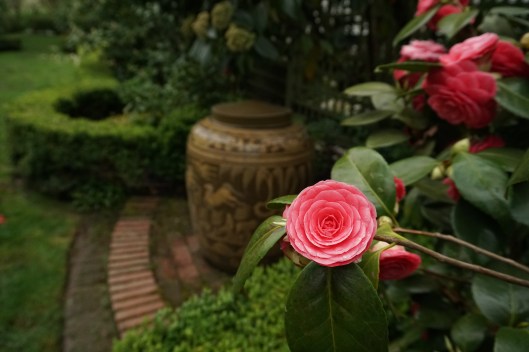
The Camellia Collection of Lord and Schryver is still going strong, while we have some work to figure out what all the old names are, it’s a spring pleasure to enjoy the hard contrast of the shades of White, Pink and Red set so strongly on the dark green background of the evergreen foliage.

This is one of my favorites in the Garden, the Double dark pink under the oak tree in the West Entry, it’s probably the most well behaved of the collection, only dropping a few flowers at a time. Which makes it a favorite of the gardener, because you don’t have to clean up a 100 lbs of spent blossoms every morning!

Spring Marches on

The Urn from the Pergola with the dark red blossoms of Magnolia on the brick.
11 Thursday Apr 2019
Posted in Deepwood, Lord & Schryver, Uncategorized
Thursdays are Deepwood days and some fun projects are underway! Besides the usual planting of the teahouse garden, the great room has had some new flower additions this spring. We also replaced a historic Malus ‘Firebird’ Crabapple in the Scroll garden.

The Teahouse Garden is looking splendid with the early season tulips, and the trade mark Lord and Schryver Forget-me-nots providing the foil for the spring bulbs.

Thanks to a generous donor the Lower Terrace renovation project is underway! This photo shows after the removal of the patio pavers that were crumbling away. The project is getting the steps redone, a new pathway surface to prevent erosion, the patio relaid, and the historic arbor rebuilt. The Lord and Schryver drawing hanging at Gaiety Hollow shows the arbor with Clematis on the West side and a canopy of Lilacs with Peonies underneath. Stay tuned for updates on this wonderful restoration taking place.
17 Wednesday Jan 2018
Posted in Gaiety Hollow, Garden, gardening, Pruning, trees, Uncategorized, weeds, winter
Is it winter or is it spring? This weather has me totally confused. I thought I had at least a month to sit in my office and write, but the sunshine these past few days has me anxiously staring at the hellebores and daffodils in bud. Should I drop everything and garden?
My answer to that is Yes, but judiciously.
There are lots of simple tasks that can be done in the garden in January that will save you from insanity in March. Why not tackle them on sunny days? Here’s what we’ll be doing at Gaiety Hollow in the next month.

Now is also a good time to look at the structure of your deciduous trees and shrubs. Look for dead branches, crossing branches, and branches that are growing towards the center of the plant. Call an arborist now and get on their work schedule. If you plan to do it yourself, make notes, take pictures, or tie tape on branches you plan to remove later in the season.
Don’t get too hasty on pruning! I am very tempted to start pruning our overgrown boxwood, but I have been warned that it is better to wait until February. Roses are another plant you might have an urge to cut. Don’t do it. Severe cold weather–like we had around this time last year–could damage or kill recently pruned plants. It’s not worth the risk.
To prevent soil compaction, limit the amount you walk in flower beds and grass. Put down sheets of plywood if you must walk on ground that is soggy. Is the ground too wet and you don’t have plywood? Sounds like the perfect excuse to go inside and have a cup of tea.
What about all of those rainy days coming up? Stay inside and dream big dreams for your garden! It’s time to order seeds and spring planted bulbs, like Dahlia, Canna, and Gladiolus. Don’t forget to purchase seed starting supplies and new tools while you are at it. You can use this calendar to help know when to start your seeds (Salem’s average last frost date is 5/22).

Need some inspiration? There are so many wonderful books on gardening to get you started. I recently picked up Clyde Waschsberger’s gardening memoir and loved it. What’s your favorite garden related book? Or which gardening book are you reading now?

10 Wednesday Jan 2018
Tags
brick pathways, brick restoration, flowers, gardening, January, Oregon, pedestal, repairing historic garden hardscape
After a two week break and a trip back to the frozen tundra of Michigan, I am back at Gaiety Hollow and Deepwood.
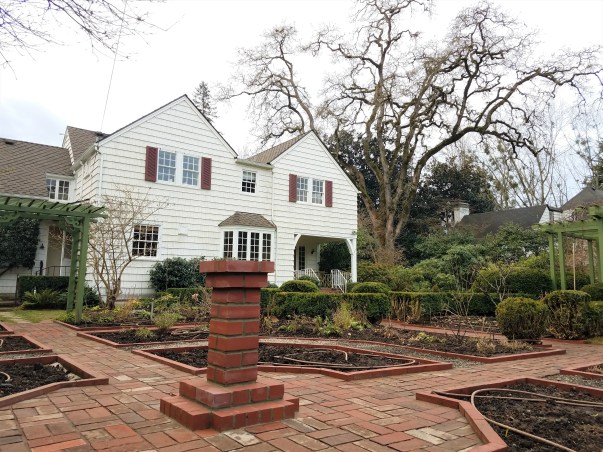
Earlier this week, contractors finished building the pedestal at the center of the Parterre Garden at Gaiety Hollow. It is beautiful!

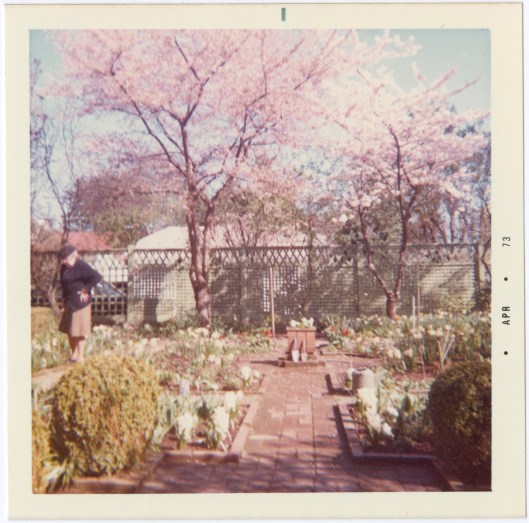
We don’t know why the pedestal was removed or when it came down. Our last photo of it was taken in 1969. Photos from 1973 show that it had been replaced by a pot.


And where, oh where, did the dear putto go? We have no clues as to where he ended up. We think he was cast in bronze and measured 18-24 inches tall. Our earliest images of him are from glass slides taken c. 1930.

He may have come from the Lord family garden. We have lots of eyes looking for a suitable replacement, but as of yet none have turned up.
I am thrilled by the attention to detail that the mason, Julian, gave the pedestal. After showing him pictures, he made sure to line up the mortar joints as they were historically.
Many thanks to our grant partners, the Oregon Cultural Trust and the State Historic Preservation Office, and to our donors, for their support of the brick walks project.
What else is going at Gaiety Hollow and the Conservancy?
Our winter flowers are beginning to bloom. Visitors might notice the scents of Sarcococca and Viburnum x bodnantense near the kitchen porch. Those who venture into the West Allee will find an early-blooming Camellia japonica. Primroses are blooming in the Evergreen Garden, hellebores are in bud, and I can see spring bulbs beginning to push up their greenery in the Parterre Garden.
Meanwhile, we have a new class of docents being trained to lead guided tours of both Gaiety Hollow and Deepwood. Volunteer gardener enrichment programs will take place in late January and February. Plans are underway for a film screening at Salem Cinema in March (more details to come!). And the Treatment Plan for the restoration of the garden is being written.
12 Tuesday Dec 2017
Tags
brick pathways, brick restoration, December, gardening, Historic Gardens, historic preservation, Oregon, Restoration, Volunteering
It has been more than a month since I last posted about our brick walk restoration project. They are not finished, but we hope to have them completed by the end of this week. I should note that we have concentrated our efforts on the paths in and around the Parterre Garden (sometimes called the Flower Garden) because they were in an obvious state of disrepair.
Returning visitors to Gaiety Hollow will immediately notice how much better the walks look and feel under your feet. They are now straight and level. The bricks that edge the path are all new and give the paths a crisp, clean look.
We aren’t completely clear on the history of the brick paths. There is speculation that parts of the paths were originally part of Elizabeth Lord’s mother’s garden. The modes Lord house was located at the corner of High Street and Mission Street, but the property encompassed approximately 1/4 of the city block. Juliet Lord was well known for her extensive flower gardens and Elizabeth credited her mother for teaching her to love gardens. Undated hand-colored lantern slides show the Gaiety Hollow property, but we are uncertain if they are of Juliet Lord’s gardens or Edith and Elizabeth’s gardens.

Undated; the Parterre Garden, looking north
We can say, however, that the paths were constructed by the early 1930s. Edith and Elizabeth moved into the Gaiety Hollow house in 1932. Dated photographs and plans from the 1930s show the layout of the paths.

In the intervening 85 yeas, the paths fell into disrepair. Between the untold number of enthusiastic gardeners who have trod these paths, and the countless wheelbarrows of compost rolling over them, and seasons of freezing and thawing, many bricks had sunken, shifted, and broken. We discovered that a few of the paths had been redone during the intervening years and set in concrete mortar. Those paths we left as-is. Other paths were set on sand and gravel and had severely degraded. A laser level indicated that they were 2 inches lower than the paths on mortar!
When we took on this project, we decided that we wanted to restore the paths to how Edith and Elizabeth knew them. Visitors will feel like they have stepped back in time to the years Edith and Elizabeth were living and working at Gaiety Hollow (1932-1969).
There are changes that will be new to visitors, but they would not be new to Edith and Elizabeth. We have chosen to reconstruct the brick pedestal that stood at the intersection of the Parterre Garden until 1970. We removed the wide brick path leading to the Pergola and replaced the narrow path and grass strips that were there until around 1970. We also removed the degrading pavers in the north path and replaced them with grass that we can see in an early photograph and plan.
We did elect to make a few changes: We raised the grade of some of the paths slightly to improve drainage and all the bricks along the path edges were replaced. Visitors should not notice the grade change. The new bricks fit well with the old, but visitors will perceive that they are newer and it will create an opportunity for us to explain the garden’s story.
When you visit the gardens next season, you might notice a few quirks in the paths and the patterns of the bricks. Someone repairing the paths years ago must have made a few changes. We replaced the bricks exactly as they were (to the consternation of mason Julian).
All in all, the Parterre Garden has been restored to its original beauty. Visitors will be able to clearly see Edith and Elizabeth’s vision for the garden and the geometry of the design.
A small group of dedicated volunteers planted our spring blooming bulbs last week (Thank you!) and I am making plans for the perennials that we will plant in the spring. I hope that you visit us in 2018 and enjoy the progress we are making.
Many thanks to our grant partners, the Oregon Cultural Trust and the State Historic Preservation Office, to our donors, and to our volunteers, for making this project possible.
21 Tuesday Nov 2017
Posted in Deepwood, Gaiety Hollow, gardening, Uncategorized, weeds
Last week, I left you all with a cliff-hanger. What is this weed that I loath?

Campanula rapunculoides
This is Campanula rapunculoides aka creeping bellflower or rampion bellflower. It is native to Europe and Eurasia and was brought here as an ornamental garden plant. However, it quickly takes over a garden and makes it look messy and weedy. Over time, it will choke out favorite plants.

Flowers
Like the Arum that I wrote about last week, C. rapunculoides has underground root structures that make it difficult to eradicate. Pulling the leaves will not remove the roots. A few surface roots will come up but, little do you know, 6 inches to a foot below the surface lurk large, fleshy, white tuber-like roots that hold energy to regenerate the plant.

Roots with top growth and leaves
To get rid of the plant, you must remove all of the underground root structures. C. rapunculoides is resistant to some herbicides. Other herbicides must be applied more than once to fully kill the plants. In a garden setting, where C. rapunculoides likes to grow inside your perennial, it can be very difficult to apply an herbicide effectively.
Digging it out seems to be the only way to remove it in a garden. I have resorted to digging up perennials–like the peony in the photo above–and sorting out the roots before replanting. Undoubtedly, I have missed a few roots and constant vigilance is demanded to prevent it from taking over again.

Hiding in the Phlox at Deepwood
When it is impossible to dig out the roots, like when it is growing in a boxwood hedge, the top growth can be pulled or an herbicide dabbed on. If the leaves and stems are removed as soon as they appear, eventually the roots will be depleted of energy and die. Always read the label of herbicides and do some basic research before applying to make sure that C. rapunculoides is susceptible and that conditions are favorable for the most impact. Remove all flowers before they spread their thousands of seeds to the wind.

Growing in a calla lily
I want to stress that this plant is not classified as invasive in Oregon. However, it is an nuisance in the garden and one of the plants I am working hardest to eradicate. It is listed as invasive in other states.
I also want to point out that not all Campanula are evil. Lord & Schryver loved their Campanula medium, Canterbury bells, and so do I. They are lovely annual or biennial plants that die after flowering. They have no fleshy underground roots or runners to carry them to other places in your garden. There are many other Campanula species and cultivars sold in the nursery trade. Below are three different kinds of Campanula we grow at Gaiety Hollow and Deepwood.
Next week, we’ll cover one more weed. It might be called “the scourge of Gaiety Hollow.” Can you guess what it is?
15 Wednesday Nov 2017
Posted in Gaiety Hollow, Garden, gardening, Uncategorized, weeds
Right now is the perfect time to tackle some of our most noxious garden weeds. At Gaiety Hollow, our problem weeds have underground energy storage systems that require them to be dug out.
Fall is a great time to remove these weeds for three reasons:
Which weeds plague us the most? I’ll cover our top three nemeses in the next two weeks. First up:

Arum italicum
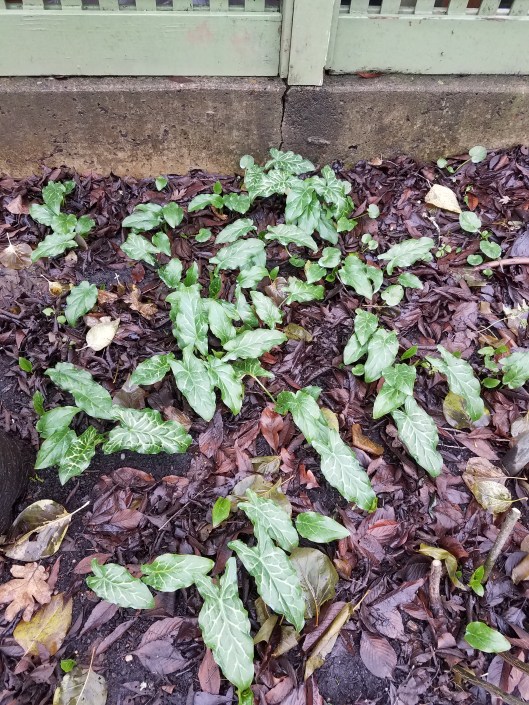
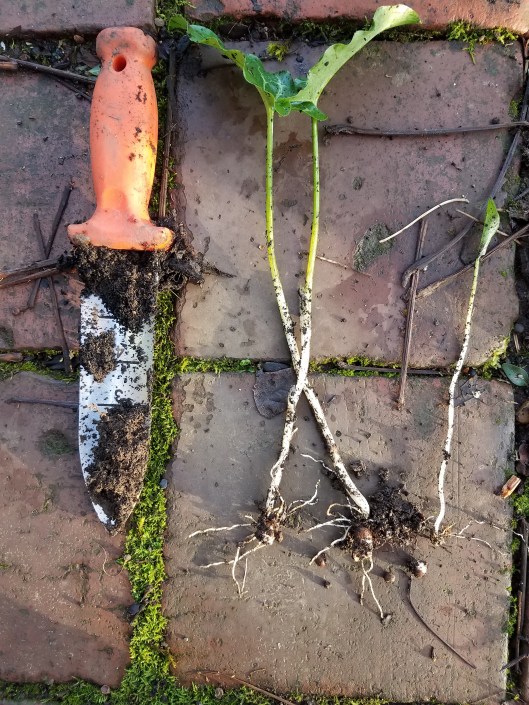
Arum italicum shows up at this time of year. Its glossy green, arrow-shaped leaves pop up through the garden soil after months of dormancy. In late spring, it flowers, a white-green spadix and spathe reminiscent of a calla lily or peace lily. In late summer, the fruit is red-orange and ornamental. Once you see the pretty green leaves in late autumn and the bright fruit, you understand why someone would grow it as an ornamental. On the other hand, once you see it taking over your shade garden, you will understand why I loath it.

In a garden setting, it seems the only way to remove it is by digging. The leaf has a waxy coating that makes it almost impenetrable by herbicides. Pulling the leaves does not remove the the root structure below the ground–a corm–which stores energy so that if the leaf dies, it can regrow.
Digging seems to be the only way to take down the numbers, BUT you must do it right or you will end up with more plants.
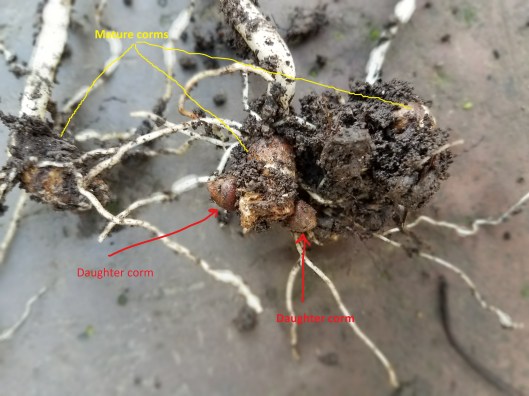
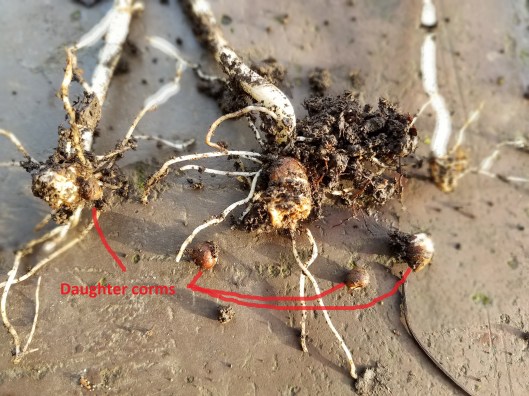
When you dig Arum you have to be very careful. Go deep. As you lift a clump out of the ground, you will notice that there is a corm at the bottom of the leaf. Looking more closely, you may notice many, many more tiny brown daughter corms attached to the large corm (they look almost like a nut). If any one of these falls off, it becomes a new plant. This is the reason why some people say that digging Arum only produces more plants.

My recommendation? Dig out Arum in clumps, put the corms and attached dirt directly into a garbage bag, tie the bag, and dispose of it in the garbage. You do not want to put the corms in compost (it will not get hot enough to kill the corms). Don’t try removing the dirt from the clump; you will unwittingly spread the minuscule daughter tubers. All of it should go in the trash.

Corms disguised by dirt. Can you see the brown “daughter” corm in the center?


Unfortunately, you are not going to get out all the corms your first year tackling Arum. This is a multi-year eradication project. I’m on year two at Gaiety Hollow.
My second recommendation? Buy a new house with no Arum in the yard.
I’m only half kidding!
Whatever you do, do not introduce this plant to your garden. If you have Arum in your yard, assume that any plant you dig up could be contaminated and do not give it away to unsuspecting friends.
More information from the City of Portland and the National Park Service.
Next week, this little terror.

30 Monday Oct 2017
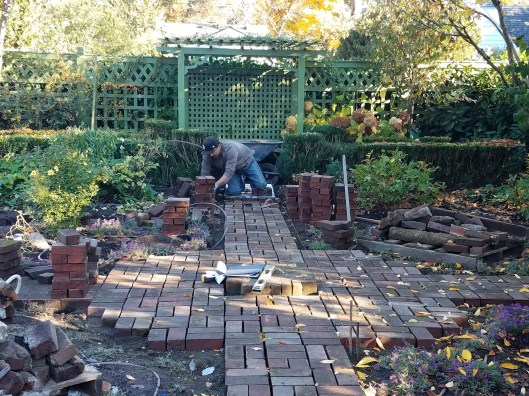
The brick walk project is well underway! We are so thrilled to see the paths coming back together. The Autumn Leaf crew has been onsite for the past week and will continue work this week.
Before work commenced, I took over ninety photographs of the paths. Julian, foreman for this project, has them all printed out so that he can re-create the paths exactly as they were. He has found a few quirks that I had not noticed, like a course of cut bricks near the middle of a path. We have no records other than photographs to help us understand how the paths evolved over time. There are many days I wish Elizabeth had written something in her journal about bricks! Perhaps the paths were Edith’s forte.
We are making a few subtle improvements to the paths as we go forward. Pooling water was frequently a problem, so we have elected to gently raise the grade of some of the paths to increase drainage. We are re-using the old bricks as the walking surface throughout the Parterre Garden (Flower Garden). The brick borders will be completely replaced with new bricks. This will provide visual consistency and be easy for docents to interpret. New bricks will also make up the path that leads to the Pergola.

Julian at work this morning
As soon as the bricks are finished, we will start planting spring blooming bulbs. We’re already looking forward to our first Open Garden in March 2018!
04 Wednesday Oct 2017
Posted in brick paths, Flower Garden, Gaiety Hollow, Garden, Lord & Schryver, Restoration, Uncategorized
Tags
boxwood, brick pathways, brick restoration, historic preservation, Oregon, rehabilitation, September, Volunteering
If you haven’t been to Gaiety Hollow in the past week, you might not recognize the Flower Garden!
Last Wednesday evening, Dave Hiser brought his youth group from the The Church of Jesus Christ of Latter-day Saints in South Salem to Gaiety Hollow. Racing against the setting sun, 25 energetic youth and 5 adult supervisors pulled up the brick paths, scraped off sand and mud, and stacked the bricks on pallets. The north path made of crumbling pavers and concrete was demolished with a sledgehammer and is heading to the landfill.
They finished the evening with zucchini bread, long drinks of cold water, and a group photo on the lawn.

Thanks to these wonderful volunteers, the brick walks in the Flower Garden are almost ready for a make-over.
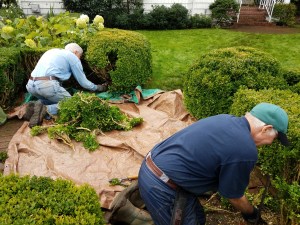
On Friday, our garden volunteers joined the efforts. Undeterred by rain, they cleaned up rubble, knocked out edging bricks, discovered more bricks hidden under an old path, and smoothed paths for walking. Pruning the boxwood away from the bricks elicited excitement from some, groans from others, and lots of jokes.

There are still a few preparations to be done before our contractors come in–removing the short path going to the shed, taking out the edges of the paths–but we should be ready by early next week. The historic bricks are being saved so that masons can reuse them in the paths and retain the feeling of charm so integral to the gardens.

When this construction is complete, the Flower Garden should look as Edith and Elizabeth intended it. Smooth paths. Clean edges in straight lines. No more pooling water. The pedestal and putto as the central focal point. Grass in the north path. Grass and a brick path to the Pergola. The geometry and bones that Edith and Elizabeth so purposefully laid out will be restored.
Words of caution: If you are visiting the garden as a volunteer or for a meeting during October, please approach Gaiety Hollow from Mission Street to avoid walking through the construction zone in the back gardens and to avoid interrupting our contractors when they are onsite. We want all of our visitors to be safe while at Gaiety Hollow. Thank you!